.webp)
Remortgage With Bad Credit

Yes, you can remortgage with bad credit even if your credit's taken a knock since you first got the keys.
A lot of people assume once there's a mark on the file, you're stuck. Stuck on whatever rate your current lender decides to offer you. You're not. You've just got fewer options, not zero.
There are two routes. Stay with your current lender and move onto one of their new rates, usually quick, simple, and often with no fresh credit check. Or go out to the whole market and see if a different lender will do better. Which one actually wins depends on your situation, and it's rarely the one your current lender pushes first.
We're Bad Credit Queen, FCA-regulated, whole-of-market and we've seen every version of 'my credit's a bit messier than last time.' We compare both routes properly so you're not just taking the first thing that's put in front of you.
Can You Remortgage With Bad Credit?
Bad credit affects which lenders will consider your remortgage and on what terms. But the options are real, and they are more varied than most people expect.
Four factors carry the most weight in a bad credit remortgage application:
- The type of credit issue. Whether that is a CCJ, a default, missed payments, or an IVA.
- The recency of the issue. Older problems carry far less weight.
- Your loan-to-value ratio. More equity means more options.
- Your income stability. Lenders need confidence you can meet the repayments.
A product transfer with your existing lender is often the easiest first step. It usually does not require a new credit check, which removes a significant barrier if your credit history is poor.
If your credit history includes specific issues like CCJs or defaults, our adverse credit mortgage advice covers the full range of situations we help with.
What Is a Product Transfer and Why Does It Matter?
A product transfer means switching to a new rate deal with your existing lender when your current fixed or tracker deal ends. You stay with the same lender and simply move onto one of their available rates.
This is different from remortgaging. A remortgage means moving your mortgage to a completely different lender, which requires a full application and a fresh credit assessment.
The biggest advantage of a product transfer for borrowers with bad credit is that most do not require a new credit check. Your existing lender already knows your history. You are already on their books, and they can see your payment record directly.
The limitation is that you are restricted to whatever product transfer rates that lender is offering. These may be competitive or they may not. Without comparing them against the wider market, you have no way of knowing whether you are getting a fair deal.
A product transfer often makes more sense than remortgaging when your credit has worsened significantly since you took out your original mortgage. It avoids the risk of a declined remortgage application leaving a hard search on your credit file.
Product Transfer or Remortgage: Which Is Better With Bad Credit?
There is no one-size-fits-all answer. The right choice depends on where your credit stands today, what rates are available, and what you are trying to achieve. Broadly, it breaks down like this:
A whole-of-market broker runs this comparison for you. You end up with the best outcome available, not just the easiest one to arrange.
Never make this decision in isolation. What looks like the obvious choice often is not, once all the options are laid out with the real numbers attached.
Can You Remortgage With a CCJ or Default?
Definitely. A CCJ or default on your credit file does not stop you from remortgaging. Specialist lenders consider these applications regularly.
Three factors shape their decision:
- Whether the CCJ or default has been satisfied
- How old it is
- How much equity you have in your property
A satisfied CCJ or default is viewed more favourably than an unsatisfied one. Both can be worked with, but a satisfied marker opens up more lender options.
The older the CCJ or default, the wider your choice becomes. After three years, significantly more specialist lenders will consider your application.
Our dedicated mortgage with a CCJ or default page covers everything you need to know about getting a mortgage with these credit markers.
What Happens If You Stay on Your Lender’s Standard Variable Rate?
When your fixed or tracker deal ends, your mortgage automatically moves to your lender's Standard Variable Rate, or SVR. This happens without you doing anything.
The SVR is the default rate your lender charges when no deal is in place. It is set by the lender and can change at any time, which means your monthly payment can rise with little warning.
SVR is expensive. It is typically one to three percentage points higher than the fixed rates available on the market. On a £150,000 mortgage balance, that difference can mean paying roughly £150 to £375 extra every month.
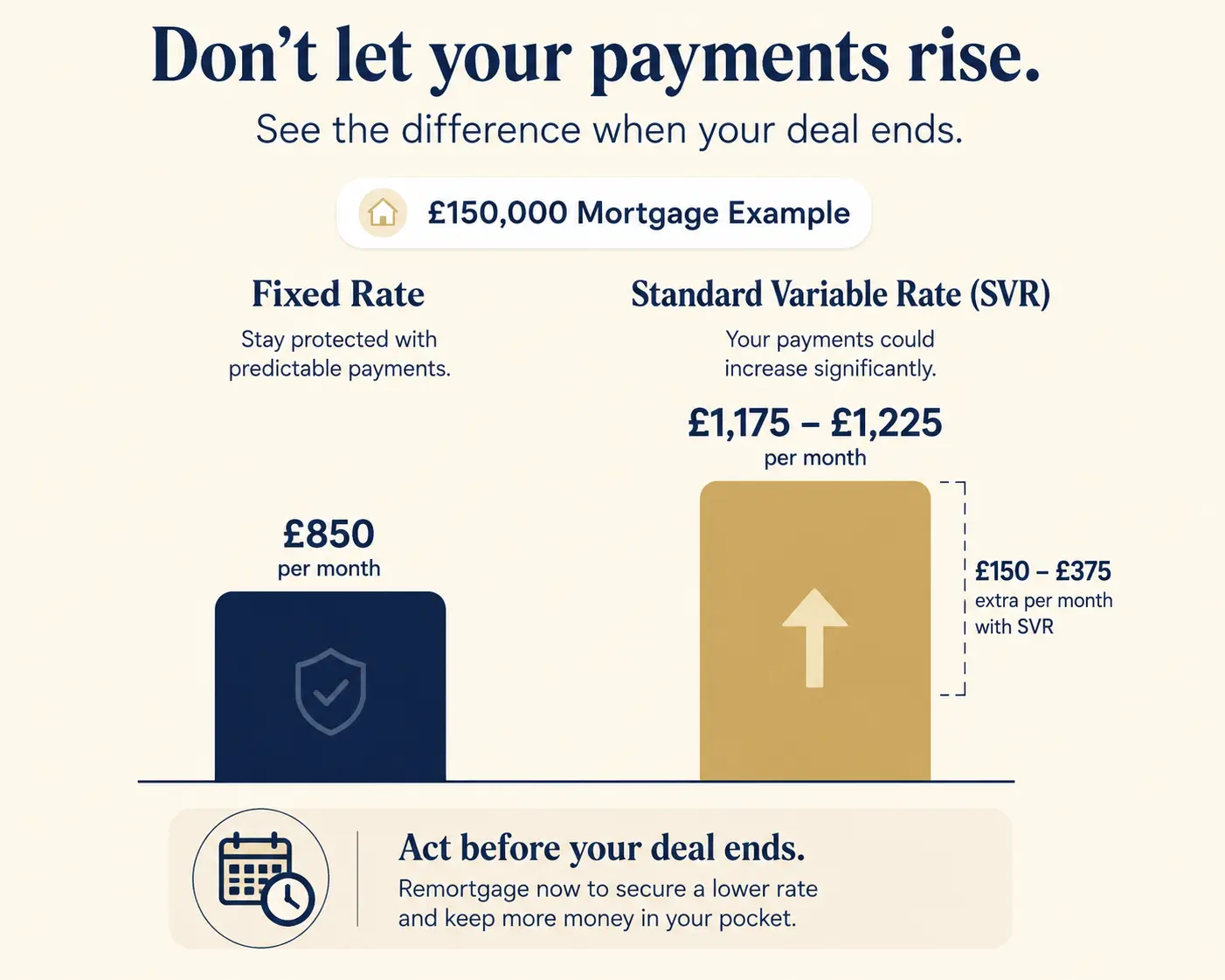
People stay on the SVR for three main reasons:
- They forget to switch when their deal ends
- They assume switching is too complicated
- They assume their bad credit means they cannot switch at all (this last assumption is usually wrong)
The fix is straightforward. A product transfer with your existing lender is usually available and is the quickest route off the SVR. A remortgage to a specialist lender may save you more, depending on your circumstances.
Act early. You do not have to wait until your deal ends. You can arrange a new deal up to six months in advance and time it to start the day your current one finishes.
Want to know what your options actually look like? Share your details with us and we will compare what is available, whether that is a product transfer with your current lender or a remortgage with a specialist. No cost, no obligation, no impact on your credit file.
Can You Remortgage to Consolidate Debt With Bad Credit?
Yes. For many homeowners with bad credit, debt consolidation is the primary reason for remortgaging.
It works by borrowing against the equity in your home to pay off unsecured debts such as credit cards, personal loans, and overdrafts. Those debts are folded into one monthly mortgage payment.
The potential benefit is real. Unsecured debts often carry much higher interest rates than a mortgage. Consolidating them can lower your total monthly outgoings significantly and simplify your finances into a single payment.
The risks are equally real and you need to weigh them properly. You are converting unsecured debt into debt secured against your home. If you fall behind on the mortgage, your home is at risk in a way it was not before. The debt term also extends, often by many years, which means you may pay more interest overall even though the monthly payment is lower.
Debt consolidation is not always the right choice. It works well for homeowners with enough equity, stable income, and the discipline not to run up new unsecured debt once the old balances are cleared. It works badly for anyone likely to repeat the same borrowing pattern.
A broker gives you an honest assessment of whether this is the right move for your specific situation, including the cases where the answer is no.
What If My Credit Has Got Worse Since I Took Out My Mortgage?
This is one of the most common situations we help with, and your options are better than you might expect.
If your credit has deteriorated since your original mortgage, your existing lender may still offer you a product transfer at a reasonable rate. Most product transfers do not involve a new credit check, so a worsened credit file does not block this route.
Remortgaging to a new lender does involve a fresh credit assessment. If your credit has worsened significantly, fewer lenders will consider you. Specialist lenders will still look at your case, but the terms may reflect the additional risk.
The worse your credit position, the more important it is to get broker advice before approaching any lender directly. A broker identifies which lenders are most likely to say yes before any formal application is submitted.
Do not assume you are stuck with your current deal. Even with worsened credit, options usually exist.
Our adverse credit mortgage advice covers all the situations where credit history affects your mortgage options and what you can do about them.
When Should You Start Looking at Remortgage Options?
Start looking at your options at least three to six months before your current deal ends.
Starting early matters because lenders need time to process applications. With enough lead time, you can lock in a deal that begins the day your current one ends, with no gap spent on the SVR.
Most lenders let you agree a remortgage deal up to six months in advance. Some allow longer, which gives you room to plan properly rather than rushing a decision.
If you have bad credit, starting early gives you additional advantages. You have time to check your credit file for errors, resolve any outstanding issues, and get broker advice on how best to present your case to lenders.
The risk of waiting too long is straightforward. You miss your deal end date and slide onto the SVR for weeks or months while the new application processes. Those months at a higher rate can cost you hundreds of pounds.
Which Lenders Accept Bad Credit Remortgage Applications?
Specialist lenders, and you will not find them on comparison websites or in high-street bank branches. You access them through a broker who holds direct relationships with them and understands their individual criteria.
A whole-of-market broker searches every available option, including specialist lenders, to find the one best suited to your specific credit history, income, and loan-to-value ratio.
Applying directly to multiple lenders is damaging. Each application leaves a hard search on your credit file. Multiple rejections create a downward spiral that makes every subsequent application harder. A broker runs a soft search first, which has no impact on your credit score.
As an FCA-regulated bad credit mortgage broker, we search the whole market on your behalf so you do not risk multiple applications damaging your credit file further.
How Bad Credit Queen Handles Your Remortgage or Product Transfer
We start with a clear, no-pressure review of your situation before recommending anything.
First, we review your current mortgage. That means your deal end date, your remaining balance, your loan-to-value ratio, and your current lender. We also review your credit history and what you are trying to achieve, whether that is a lower payment, debt consolidation, equity release, or simply avoiding the SVR.
Next, we run a soft search to check your eligibility with specialist lenders. This does not affect your credit score and gives us a realistic view of what is achievable.
We then compare your current lender's product transfer rates against the wider remortgage market. You see both options side by side, with clear reasoning for which one we recommend and why.
Finally, we handle the full application, all the paperwork, and all communication with the lender on your behalf.
We are FCA-regulated and whole-of-market. Our fee is £999, payable on application. There are no upfront fees. If we cannot secure a mortgage for you through no fault of your own, the fee is fully refundable.
If now is not the right time to switch, we will tell you honestly what to work on and when to come back.
If you are self-employed and looking to remortgage with bad credit, we also specialise in self-employed bad credit mortgages.

Market-Leading Rates
We search the whole of the market so you don't have to, with access to specialist lenders and rates not available on the high street.
We compare options tailored to your financial situation and goals, focusing on what really works for your current situation - helping you find what's genuinely the best fit for you.

Flexible Repayment Options
We help you find mortgage deals that offer as much flexibility as possible when it comes to overpaying or repaying early.
We focus on options with lower early repayment charges where available, giving you more control over your finances and fewer restrictions.
.webp)
Straight forward Approval Process
You can check your eligibility through a simple and clear process designed for speed and transparency.
We guide you every step of the way with realistic expectations and no unnecessary complications.
.avif)
.avif)
.avif)
.avif)